Four innovation strategies to take your company from complacent to competitive


Innovation, that perennial cornerstone of successful businesses, has been nearly redefined recently by companies disrupting the status quo: Uber, Lyft, Amazon and Netflix, for example.
As a CEO, you might feel that business innovation has to take a back seat to some of the day-to-day responsibilities. But really, you need to rethink this idea if your business is going to compete in today’s economy.
How do I define innovation? For me, it’s not just about doing something different. It’s about doing or creating something better. It could be an improving your internal workflow to increase profitability or serving customer needs in a new way that increases your market share and changes the competitive landscape.
The first and most important step in this process is making a conscious decision about your innovation strategy. Start with a basis of two sets of opposing forces: incremental innovation versus disruptive innovation, and proactive innovation versus reactive innovation.
Incremental innovation is directed at making small improvements to your company’s existing products, services or processes for the sake of efficiency or productivity. Recent research from my company, Vistage, shows that 67 percent of CEOs from small and midsize businesses (SMBs) find this kind of innovation to be critical to company success.
Disruptive innovation unseats established businesses by creating a product or service that’s accessible to a new population of customers, usually because it’s offered at a lower cost. Fewer CEOs of SMBs currently embrace this business strategy, with only 16 percent indicating that radical innovations and technological breakthroughs are critical for their company’s success.
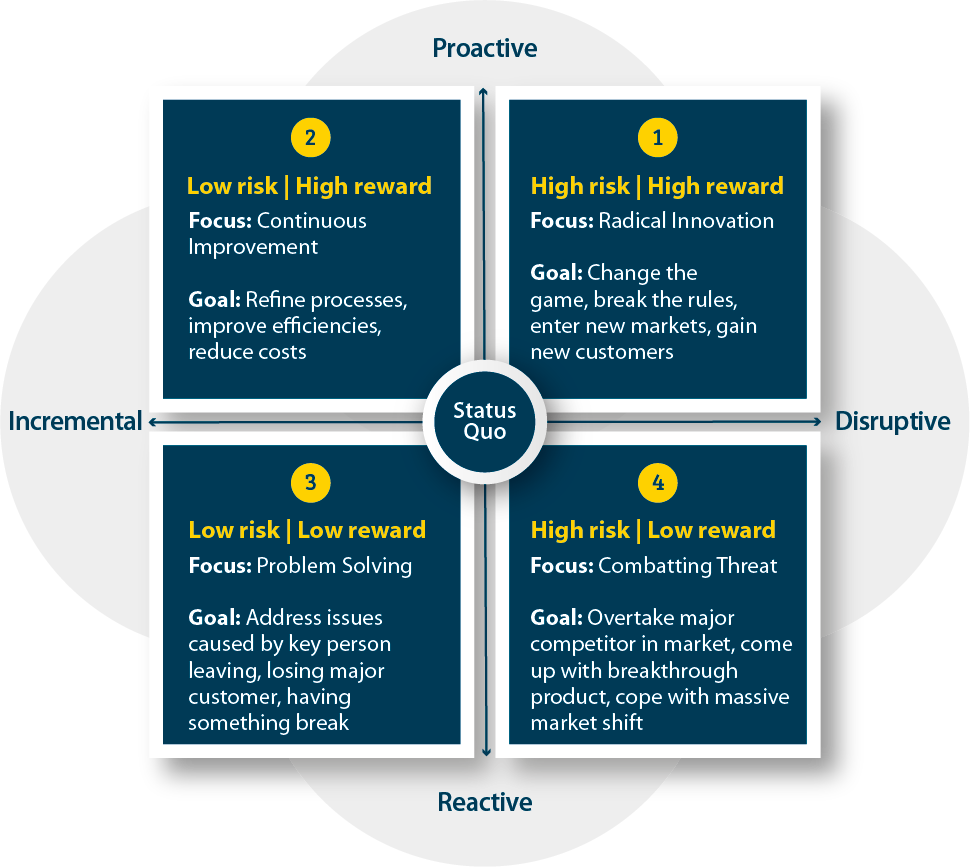
Proactive innovation is intentional and planned, and it typically requires a commitment of people, time, money and resources. Reactive innovation takes place on the fly and is triggered by an event, such as when a large client cancels a major contract.
When you combine these variables in different ways, you end up with four distinct innovation strategies that comprise the Vistage Innovation Framework, each with its own set of risks and rewards.
Four innovation strategies
1. Proactive/Disruptive Innovation
- Risk/reward ratio: High risk, high reward
- Company profile:These companies identify and reach an untapped customer segment by delivering an offering that’s more affordable or accessible than anything else on the market. Salesforce, for example, took down Siebel–and an entire category of enterprise software–with their revolutionary cloud-computing applications.
- Potential risks:This approach typically requires a major investment upfront without a guarantee of return. Innovations have the potential to fail miserably (remember the “new Coke” of 1985?), harming both revenues and reputation.
- Potential rewards: As the Salesforce example suggests, the rewards can be tremendous. You can become a category-defining company and a recognized leader in your market.
2. Proactive/Incremental Innovation
- Risk/reward ratio: Low risk, high reward
- Company profile: These companies are motivated to continuously improve everything that they do. They have a strong culture of innovation and typically have teams and leaders that are specifically dedicated to innovation.
- Potential risks: This approach requires a commitment of time, resources and talent–however, timelines tend to be shorter and investments tend to be fewer in comparison to the Proactive/Disruptive strategy.
- Potential rewards: This approach can lead to a high-performance organization, where quality and efficiency permeates all aspects of the business.
3. Reactive/Incremental Innovation
- Risk/reward ratio: Low risk, low reward
- Company profile: These companies tend to operate without innovation leadership or a formal innovation team. Innovation projects may be present, but they don’t progress–either because daily work gets in the way, resources are reallocated, timelines fall behind or there’s no accountability.
- Potential risks:Competitors that are adept at innovation are well positioned to steal market share–and your customers.
- Potential rewards: Upfront costs are lower because you don’t have a dedicated team in place.
4. Reactive/Disruptive Innovation
- Risk/reward ratio: High risk, low reward
- Company profile: These companies wait until something bad happens to try to come up with an innovative idea. For example, if a national player moves into their best market, they try to come up with a game-changing innovation on the fly.
- Potential risks: It’s very difficult to develop disruptive innovations in a moment of crisis. You’re likely to weaken your customer base and lose revenue at the same time.
- Potential rewards:If you get lucky, you can come up with an innovation that keeps your company in the game. And, if you’re even luckier, the innovation can potentially redefine your company.
There’s no single strategy that’s right for every business. To find your strategy, evaluate the risks and rewards of innovation in the context of your industry, market position, competitive environment and customer base. Once you outline these areas, the path forward will become clear.

Category : Innovation
Tags: Business Strategy About the Author: Joe Galvin
Joe Galvin is the Chief Research Officer for Vistage Worldwide. Vistage members receive the most credible, data-driven and actionable thought leadership on the strategic issues facing CEOs. Through collaboration with the Vistage community
…